Tet
Vietnamese and Chinese Lunar New Year, is the most important Festival of Vietnamese people. This sacred Festival sometime between late January or early February (depend on Lunar Calendar ) and Tet has become so familiar to the Vietnamese that when Spring arrives, the Vietnamese, wherever they may be, are all thrilled and excited with the advent of Tet, and they feel an immense nostalgia, wishing to come back to their homeland for a family reunion and a taste of the particular flavours of the Vietnamese festivities.. Although officially a three-day affair, festivities may continue for a week or more with every effort made to indulge in eating, drinking, and enjoyable social activities. It is also a time for family reunions, and for paying respect to ancestors and the elders. Gifts of food are made to friends, neighbors and relatives in the days before Tet.
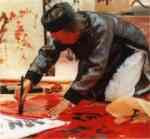
Lim Festival
The Lim Festival takes place every year on 13th day of the 1st lunar month. Visitors come to enjoy the festival and see the performances of "lien anh" and "lien chi". These are male and female farmers who sing different types of songs in the pagodas, on the hills, and in the boats. Besides this, visitors can come to the Lim Festival to enjoy the weaving competition of the Noi Due girls. They weave and sing Quan Ho songs at the same time. Like other religious festivals, the Lim Festival goes through all the ritual stages, from the procession to the worshipping ceremony, and includes other activities.

Yen Tu Pagoda festivalYen Tu Festival commences annually on the 10th day of the first lunar month and lasts three months. Tens of thousands of pilgrims begin their journey after a solemn ritual held at the base of Yen Tu Mountain. After the three-hour trekking along winding path, going through forests of pines or bamboos, tourists reach the Bronze Pagoda atop the mountain. Upon getting up there all visitors feel like entering Nirvana.
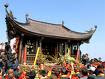
Dong Da hillock festival
Dong Da hillock festival takes place annually on the 5th (20 February 2008) of Lunar New Year. This is a victorious festival, organized in memory of the King Quang Trung's great merit - the hero in national history of anti - invaders. Two centuries ago, Dong Da was a battlefield where Quang Trung (Nguyen Hue), a Tay Son farmer who later became a National Hero defeated more than 200,000 soldiers of the Qing invading army. Dong Da Hill became a glorious historical site of the Vietnamese nation.

March
Phu Giay festivalPhu Giay festival, one of the most popular festivals in Vietnam, takes place annually from the 1st to the 10th of the third lunar month in Kim Thai commune, Vu Ban district, Nam Dinh province.Every year thousands of followers join the yearly Phu Giay Festival, Vietnam. 20 to 30 young men from every village join the festival carrying two meter long decorated bamboo sticks.

They stand in ranks to forge four Chinese characters “Mau Nghi Thien Ha”.
3rd March is the death anniversary of “The Mother”. Mother Lieu Hanh is escorted from the Van Cat Temple to Dan pagoda on 5th March and from Tien Huong Temple to Goi Pagoda on 6th March. The young men have an important role in these processions. It involves lacquered and gilded palanquins to be carried by eight people on each trip. Old women carry a long piece of cloth on their head forming “The Bridge” for geniuses and spirits to travel. Colorfully dressed young men and women holding burning incense sticks follow them dancing and chanting loudly. These processions stretch for more than two to three kilometers.
Nui Ba Festival
During this annual celebration, thousands of Buddhists and tourists flock to the Ba Mountain to worship and sightsee. The festival is celebrated during spring till the 30th day of the 1st lunar month. The festival reaches its peak on the day of the full moon of the first month when people from the Ho Chi Minh City and the provinces of the south gather in crowds at the mountain. Pilgrims start at the bottom of the mountain and climb one half of the mountain to Saint Linh Son's communal house. Then, they follow a path that leads to a pagoda.
 April
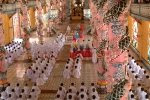
AprilHung Temple FestivalHung Temple Festival in Hanoi is one of the most royal of the national festivals that celebrate the Hung Kings, whose contribution to the foundation of the nation is revered at. As you witness this festival, you will be impressed by the tangible show of emotive natives of the land, who celebrate their love and heritage of the country almost with the passionate zeal of religious faith. It lasts for 3 days.
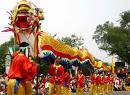
Dong nhan Village FestivalThe Trung Sisters, two Vietnamese heroines who led a rebellion against the Han invaders (40-43 AD) are not only worshipped in Hanoi, but also in Dong Nhan village (Hai Ba Trung district, Hanoi). Dong Nhan village holds its festival from the third to the sixth day of the second lunar month, date when villagers recovered the statues of the two sisters in the Red River.
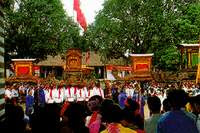
JuneGiong festivalThe Giong Festival in Hanoi is the northern festival which is celebrated annually in the Phu Dong Village, Gia Lam District in Hanoi. The widely popular Giong Festival in Hanoi is celebrated on the ninth day of the fourth month of the lunar calendar. Giong Festival in Hanoi is commemorated to honor the hero of the village, saint Giong who saved the village by defeating the An invaders. To express their honor for the hero of the village who made a sacrifice of his life to defeat the invaders, the villagers proclaimed him as Saint Giong.
August
Honchen Temple Festival
The Hon Chen Temple Festival is organized twice every year in the 3rd and the 7th lunar months. The festival takes place at the Hon Chen temple, 10 km west of Hue. It starts with a procession referred to as the God Welcoming ceremony, said to bring all the worshipped Gods from the village temples and shrines to the communal house where various rituals are performed, including the procession in honour of Saint Mother Thien Y A Na. The procession takes place at night on the Perfume River, which shines with a myriad of lights. The procession ivolves a long line of boats bound together into bigger rafts.
September
Mid-autumn Festival
For a long time, Vietnam and some other Asian countries who follow the rite of worshipping the Moon Genie, welcome the Mid-Autumn Festival on the 15th day of the 8th lunar month. This is the time when the moon is full, the farm work is at rest, and the weather is cool and fresh. Apart from the Lunar New Year, the Mid-Autumn Festival is the most impressive event for the Vietnamese, particularly the children. There is no other event in the year other than this festival that provides them with as much entertainment, toys, cakes, candies, and fruit.
Doson Buffalo Fighting Competition
The Buffalo Fight in Do Son (Haiphong City) is officially held every year on the 9th day of the 8th month of the lunar calendar. There are, in fact, two rounds of elimination before the middle of the 5th month and 8th day of the 6th lunar month.
The preparation for this festival is very elaborate. Fighting buffaloes must be carefully selected, well fed, and trained. These buffaloes must be between 4 and 5 years old, with a good appearance, a wide chest, a big groin, a long neck, an acute bottom, and bow shaped horns. The fighting buffaloes are fed in separate cages to keep them from contact with common buffaloes.
Kiep Bac Festival
The Kiep Bac Temple, where people come to worship Tran Quoc Tuan, the main general of the Tran Dynasty, is located in Hung Dao Commune, Chi Linh District, Hai Duong Province. Tran Quoc Tuan was the general who defeated the Chinese Nguyen-Mong invaders three times. Because of his merits to the nation, he was proclaimed a saint.
October
Keo Pagoda Festival
Keo Pagoda is located in Vu Nhat commune, Thai Binh province. This great pagoda was built as early as 17th century in honour of a monk whose name has been recorded in books: Duong Khong Lo. This man was originally a fisherman, then entered religion and attained Nirvana. He knew magic and once came to the capital to cure King Ly Thanh Tong so he was honored as the teacher of princes. He had Nghiem Quang Pagoda built and later renamed it Than Quang (Keo Pagoda). The Keo Pagoda festival is annually held for three days, from 13th to 15th of the 9th lunar month to worship Buddhist Duong Khong Lo.

Oc Om Boc Festival
The Oc Om Boc Festival is a religious service to worship the moon god of the Kho Me minority group. The festival is usually held on December 15th of the Buddhist Calendar, or in October following the Gregorian Calendar. At this religious festival, people thank the moon god who brings about good crops, provides abundant fish in the rivers, and maintains the health of human beings.
During the night of the full moon, as the moon appears, people prepare a feast in the front yard of the pagoda or in their houses. A plate of green rice flakes, ripe bananas, fresh peeled coconuts, mangoes and other dishes are served to the moon god.

November/December
Kate Festival
The Kate Festival is held annually by the Cham ethnic group who inhabit the An Phuoc District of Ninh Thuan Province. The Kate Festival ia held on the first ten days of the seventh month of the Cham Calendar (this cooresponds with September or October). The Kate Festival is an occasion for the Cham people to express their venerability to their god. This god is considered the creator of the universe and is thought of as a national hero. During this festival, people go on a pilgrimage to the holy land of My Son and visit their friends and family.
 Footnotes:


 Posts
Posts


